Do you need an asset to trade in the intraday market?
Understanding how virtual trader are trading physical market - The case study of SOREX in the Spanish intraday market
Alexandre Danthine · AAG AdvisorsDo you need an asset to trade in the intraday market?
Intraday markets are usually explained as a way for producers and consumers to fix forecast errors before delivery. The note asks whether a participant can use them with no plant or load at all, buying in one session and selling in another until its position is flat. It builds on an earlier note on the Iberian continuous market, where one participant stands out for its order count. The note does not treat this as misconduct and uses the case to study liquidity and risk.
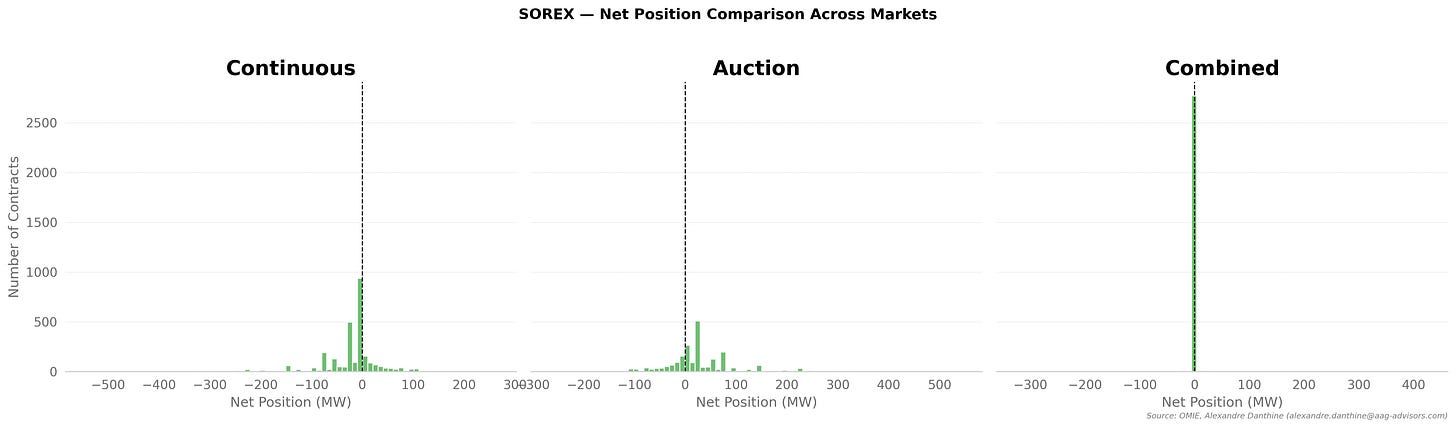
With October 2025 data, it shows that participant buying in the three Spanish intraday auctions and selling on the continuous XBID market, ending each quarter-hour close to flat. The month closes about 155,971 EUR ahead: 1.06 million EUR of continuous sales against 0.9 million EUR of auction purchases, before imbalance and exchange costs. Most continuous trades happen 1 to 6 hours before delivery. The note sees this as evidence against the claim that the continuous market is too thin to close positions, which matters for batteries.
In the full article
- Two more single-period case studies: one at negative prices and one where the trade loses money
- A look at the timing of order placement, including orders that are never filled
- How winning and losing delivery periods are distributed
The complete analysis, charts and data are on Substack. Paid subscribers get every article in full, plus the monthly market reports.