How high can Spanish electricity grid costs go?
Analysis of the evolution of congestion management (Technical Restrictions) costs in Spain
Alexandre Danthine · AAG AdvisorsThe Spanish electricity system is rapidly transforming, with almost ~28 GW of large-scale solar and wind energy added in the past five years. Renewables now represent 57.9% of peninsular Spain's electricity generation (2024), compared to 38.9% in 2019.
Nonetheless, this shift from a centralised to a decentralised system does not come without operational challenges. The best symptom of this rise in complexity is the cost of managing the grid from a security point of view.
In Spain, the system's security is handled through the Technical Restrictions market, which serves the needs of the TSO (Transmission System Operator - Red Electrica in Spain) to solve any security problem on the grid. It operates as a pay-as-bid locational market, where the price of bids is influenced by both the location and the liquidity surrounding the affected node.
These problems can be multiple, such as managing overloaded lines, voltage control, or a lack of liquidity in balancing markets.
But how much are we talking about …?
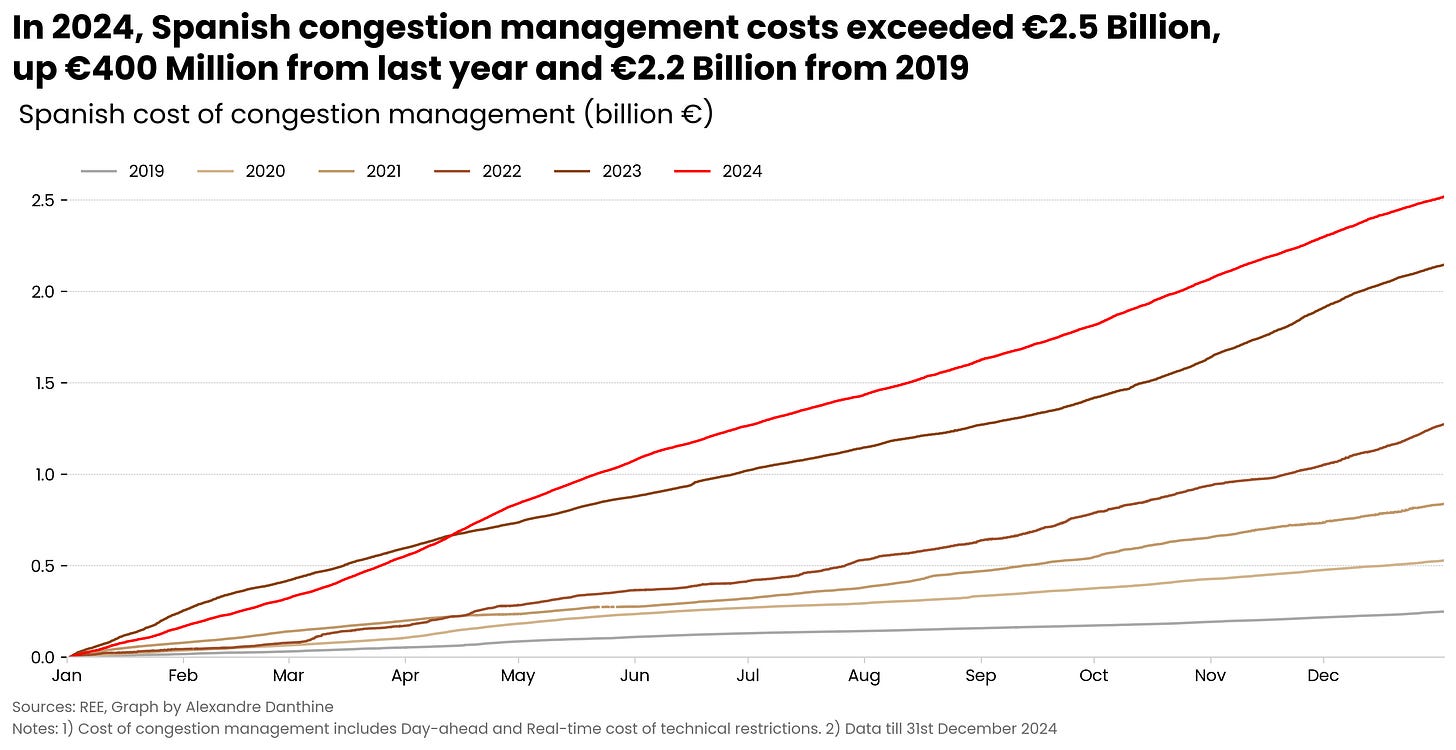
By the end of 2024, these costs represented 2.5 Bio€.
While the magnitude of the costs might be a problem, the recent trend is more alarming: They have been increasing every year for the past five years.
Costs of Technical Restrictions:
2019 → ~250 Millions€
2020 → ~500 Millions€
2021 → ~800 Millions€
2022 → ~1.200 Millions€
2023 → ~2.100 Millions€
2024 → ~2.500 Millions€
But why are these costs increasing?
First, let’s understand when those volumes are activated.
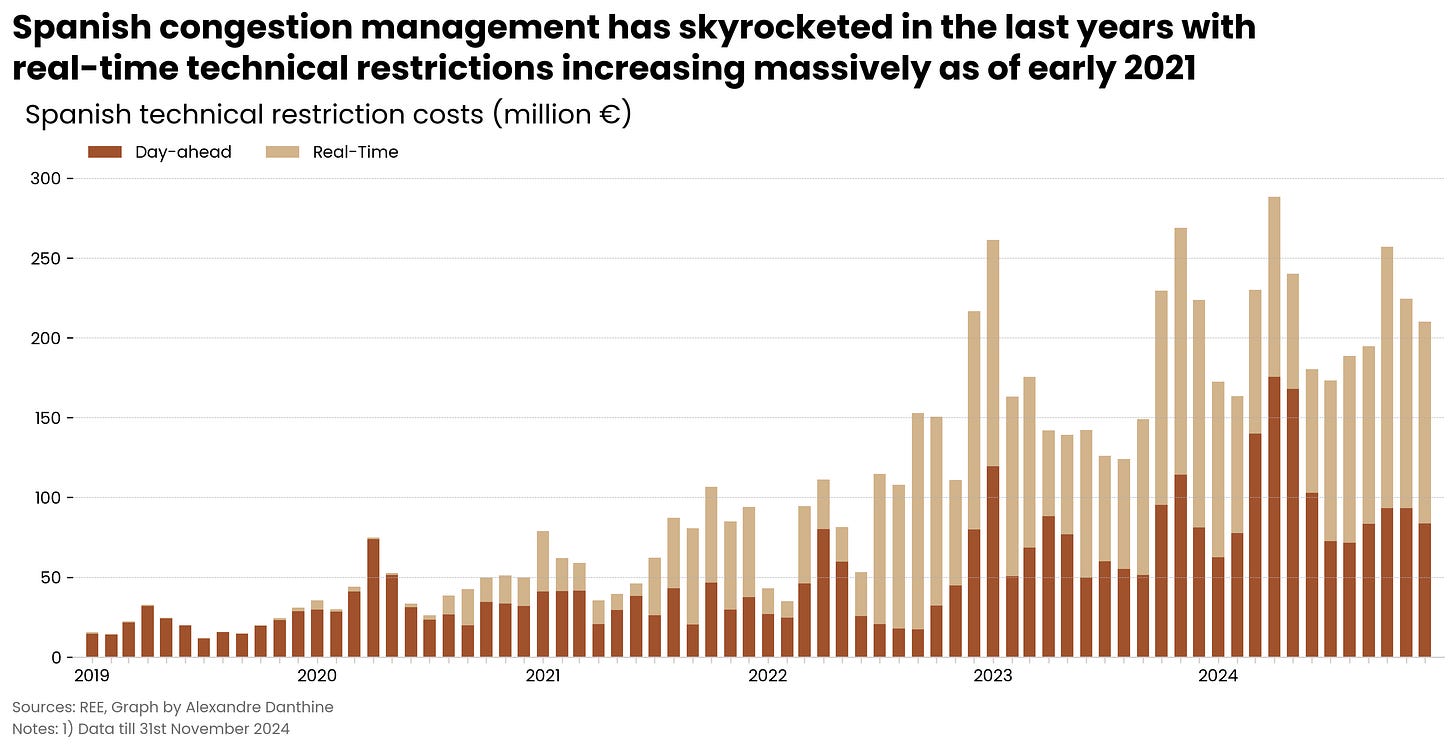
These costs are classified into two specific timeframes: day-ahead and real-time. These periods indicate when the TSO secures the system, starting immediately after the day-ahead dispatch to confirm the feasibility of the allocated bids, as day-ahead dispatch does not account for possible congestion and other factors or in real-time.
Real-time Technical Restrictions costs
Starting in mid-2020, the costs linked to technical restrictions in real-time experienced a notable increase, making up 51% of the total expenses related to technical restrictions in 2024.
What are the leading causes of this need for real-time technical constraint volumes?
The causes can be separated into three main categories:
Congestion management
Voltage control
Insufficient reserve
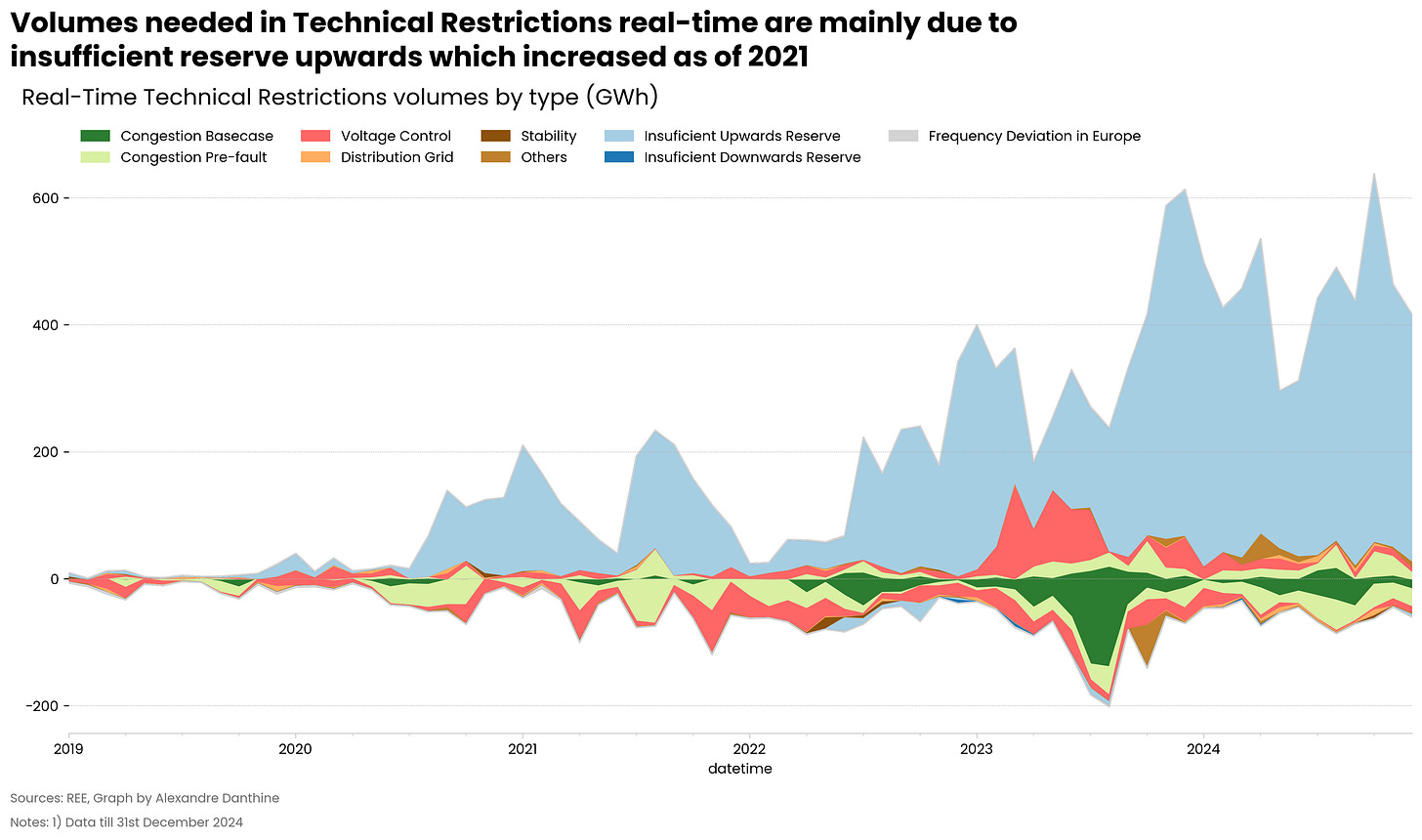
Although certain energy requirements stem from voltage management and congestion, most arise from insufficient upward reserve. Among the 6.1 TWh (5.4 TWh upward and 0.7 TWh downward) used in real-time Technical Restrictions in 2024, 4.9 TWh (~80%) was used for insufficient upward reserve.
This situation underscores the necessity to activate upward flexibility close to real-time, which could not have been fulfilled with a standard balancing mechanism, allowing demand generation to align more closely with real-time conditions.
As the energy system continues to integrate more renewables, the evolution of costs and market dynamics will depend on several critical factors, including the pace of renewable deployment, flexibility deployment, and regulatory improvements.
Additionally, regulatory frameworks will play a pivotal role in shaping the trajectory of costs and volumes. In 2024, the Technical Restrictions market will change significantly with the upcoming voltage control service, including some major changes, such as modifying offers for technical constraints, introducing penalties for non-compliance with scheduled reductions, and calculating real-time constraint costs based on imbalance prices.
Sources
https://www.ree.es/es
https://www.esios.ree.es/es
Get the next article by email. A new article on European power markets every other week, from the bid curve to the order book.