How to Think About Negative Electricity Prices: From Macro Trends to Fundamental Drivers
What drives negative bids in the Spanish day-ahead market, and how to forecast them
Alexandre Danthine · AAG AdvisorsWhat drives negative bids in the Spanish day-ahead market, and how can they be forecast?
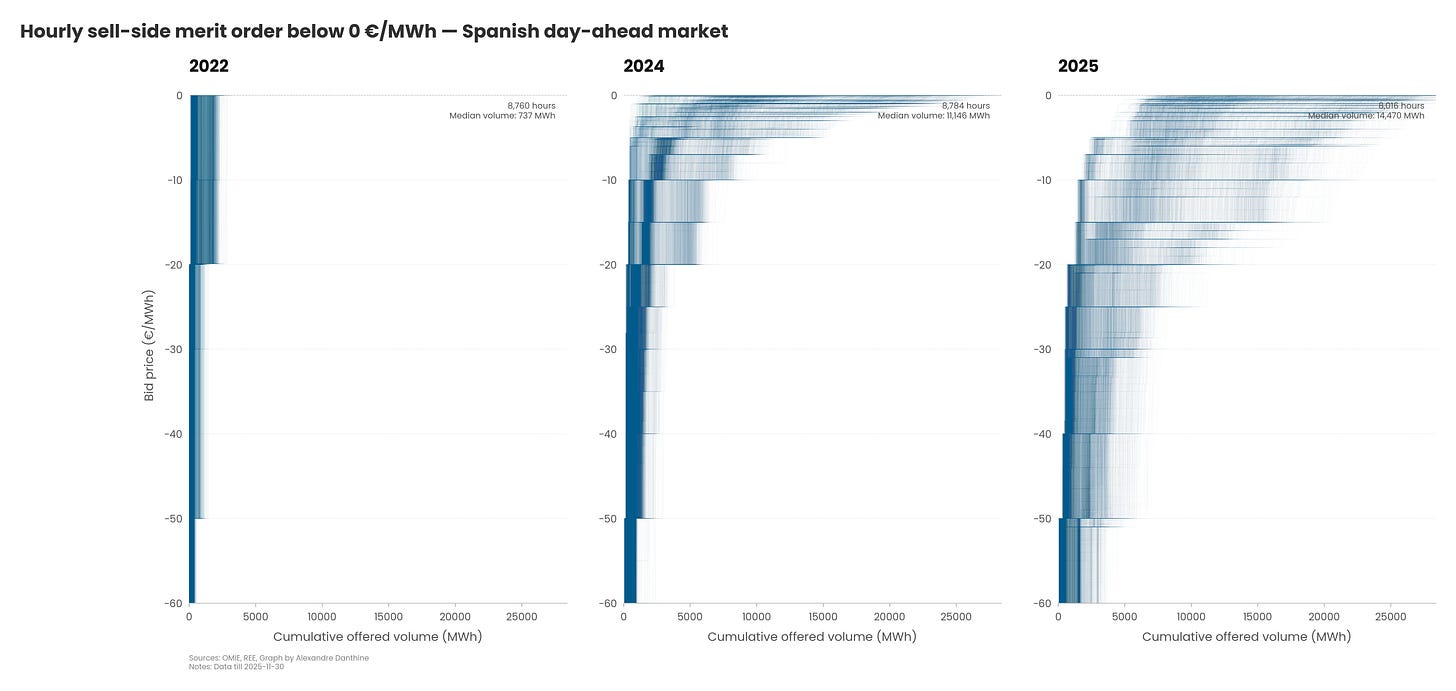
Sell bids at negative prices on Spain's day-ahead market rise from 9 TWh in 2022 to 130 TWh in 2025. The note explains why such bids are rational. Some plants face shutdown and restart costs larger than the loss from producing, subsidised wind farms lose their premium if they stop, and solar PV under long-term PPAs bids below zero to keep dispatch priority. The note then builds three analyses of increasing depth, moving from aggregate trends to the technology drivers behind hourly changes.
The first analysis, in the free part, reduces each hour's negative-bid stack to two numbers: total volume and volume-weighted average price. The median price falls from -12 EUR/MWh in 2024 to -20 EUR/MWh in 2025, with a tail beyond -100 EUR/MWh, as the solar PV fleet grows. The note shows how to feed these trends into a revenue model using a solar capacity forecast. It also states the limit of this approach: it cannot explain why one hour carries far more negative bids than the next.
In the full article
- The two separate regimes in which negative bidding operates, and why wind is a misleading signal
- One physical variable that explains when negative prices appear, and a spreadsheet method to calculate it
- A one-input regression that explains 79% of hourly negative-bid volume
The complete analysis, charts and data are on Substack. Paid subscribers get every article in full, plus the monthly market reports.