Paradoxically Rejected: When Cheap Power Does not Clear
When the algorithm rejects a bid that should have been accepted
Alexandre Danthine · AAG AdvisorsOn a day-to-day basis, Europe’s day-ahead electricity auctions matched thousands of selling or buying bids using an algorithm called EUPHEMIA.
For most bids, the outcome is straightforward: cheap generators get dispatched, expensive ones do not. But for a subset of orders, something counter-intuitive happens: a generator offers power at a competitive price, the market clears above that price, and the bid is rejected anyway.
This is known as a paradoxically rejected bid (PRB). It is not an algorithm error. The market is designed this way.
Block orders are “all-or-nothing”, fully accepted or fully rejected, with no partial execution, and they exist for good reason: a thermal plant cannot start up for a single hour. But their indivisibility means the algorithm sometimes cannot find prices that make every profitable bid work. The problem hit hardest where liquidity is thinnest: in small bidding zones (e.g., Baltics or a smaller market like FCR - primary reserve).
How it works: the merit order rule
In a day-ahead auction, generators are ranked cheapest-first in a “merit order.” Demand sets the quantity needed, and the most expensive generator needed sets the clearing price. For simplicity's sake, we’ll model demand as a fixed quantity, in other words, inelastic, something that I challenged in another article.
If you only consider simple bids, there is no issue, as some of those bids can be partially accepted to perfectly fit the demand needs.
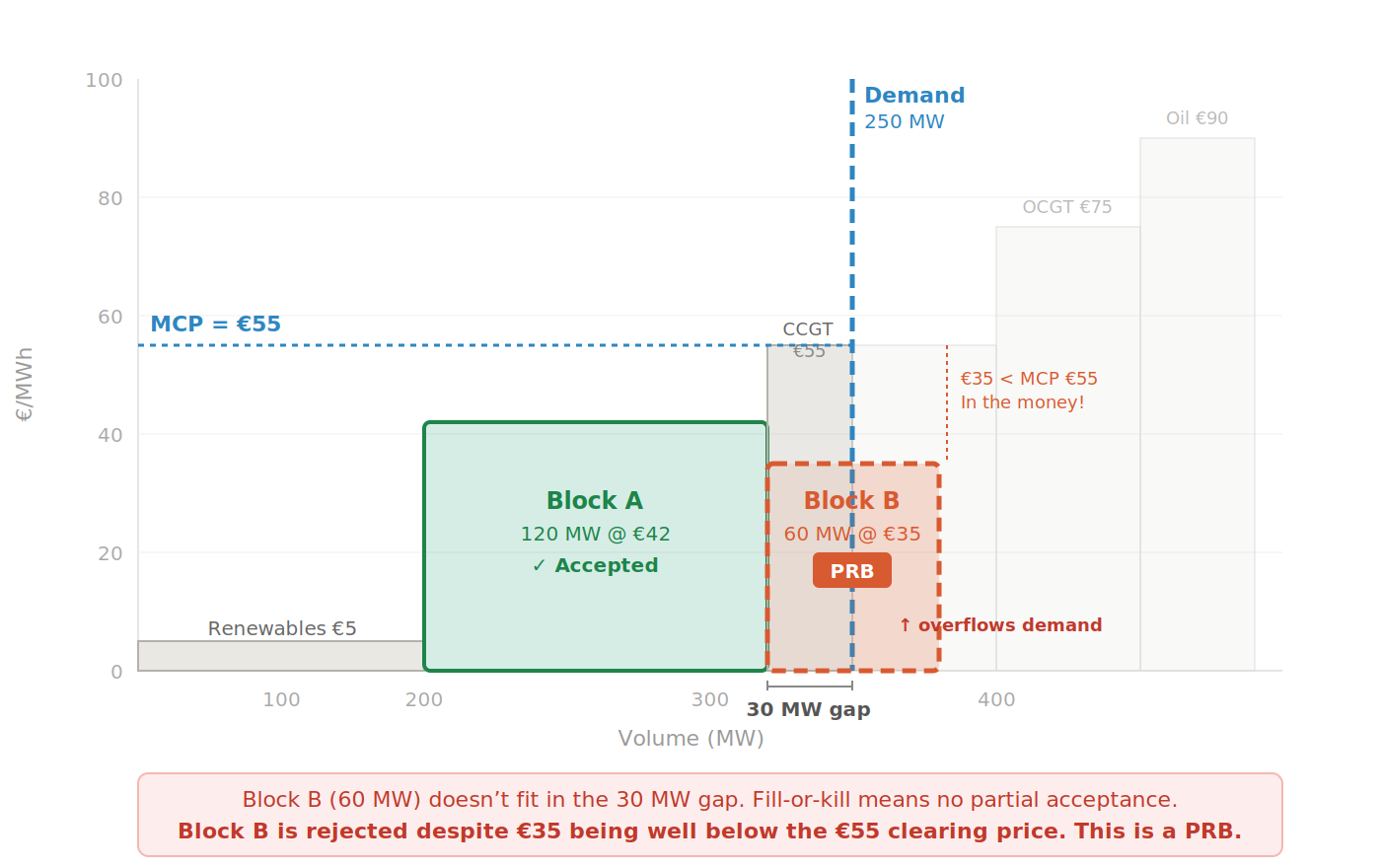
Block orders are different.
A block order means that you would sell X MW at Y EUR/MWh or nothing at all.
The algorithm faces a binary choice.
If you combine those binary choices with the core European rule that no accepted bid may lose money at the clearing prices, a block bid that is lower than the Market Clearing Price (MCP) may be rejected as a whole.
Block B is priced well below the clearing price. But it is a 60 MW block order, and only 30 MW of room remains.
Why pick Block A over the cheaper Block B?
Accepting 120 MW of Block A displaces more expensive gas than 60 MW of Block B would, so total system cost is lower. The algorithm maximizes welfare, and Block B is left out despite being the cheaper bid.
European markets enforce one strict principle: no accepted block may lose money at the clearing price. Because blocks are also fill-or-kill, a profitable block that cannot be accommodated must be rejected in full.
Simple orders, which can be partially accepted, escape this behavior.
While this behavior will happen on a quarter-hourly basis, like in the graph above, block bids can also be linked across several quarter hours, which can lead to even less intuitive rejection.
Small markets feel it most
The PRB problem is structurally worse in small, illiquid markets: each block is a larger share of total volume, so accepting or rejecting it moves the price more.
The Baltics: thin liquidity, outsized blocks
The Baltics (Estonia, Latvia, and Lithuania) are among the smallest and least liquid bidding zones in the coupled European market, while much of their supply comes from a handful of large generators.
When those generators submit blocks, each one is big relative to the whole market: a single acceptance or rejection can swing the clearing price by several euros, enough to trigger cascading rejections of other blocks.
Belgian FCR: the same paradox in ancillary services
The same mechanism shows up outside the day-ahead market, wherever indivisible bids meet a clearing algorithm.
The FCR Cooperation, the cross-border auction for frequency primary reserve covering a big part of Europe, allows indivisible bids of up to 25 MW.
In Belgium, the prices stayed high for a long time as only a few MW proposed as block bids could lead the algorithm to choose those high prices block bids.
Conclusion
There is no patch for paradoxically rejected bids.
They follow from two design choices:
A single clearing price for everyone, and a strict rule that no accepted bid may lose money.
As long as the market also accepts all-or-nothing block orders, there will be days when those three things cannot hold at once, and a profitable bid gets rejected to keep the rest of the dispatch consistent.
Interestingly, measures of liquidity often mention only volumes, while the divisibility of the bids they are composed of can affect how smoothly the price is set.
One conclusion stands: the market-clearing price (i.e., Day-ahead, FCR, …) does not always reflect the cheapest possible dispatch. In thin bidding zones and on volatile days, it is important to remember that somewhere in the order book, a perfectly competitive bid may have been turned away.
Hope you enjoyed this article; feel free to react in the comments or by message!
Best,
Alexandre (alexandre.danthine@aag-advisors.com)
Get the next article by email. A new article on European power markets every other week, from the bid curve to the order book.