The Three Faces of Curtailment
Market, grid, and flexibility: What do they mean?
Alexandre Danthine · AAG AdvisorsCurtailment of renewables is back in the headlines across Europe: 9.3TWh of wind curtailed in FY2024/2025 in Great Britain, while 9.4TWh curtailed in Germany last year.
But “curtailment” is not a single phenomenon.
It can arise for very different reasons, and those reasons determine whether it undermines the project’s economics or opens up an additional line of income.
In this article, we’ll break down the sources of curtailment, explain how they differ, and illustrate when each one benefits or harms.
What is the definition of curtailment?
As a non-native English speaker, I find it helpful to refresh my understanding with the precise wording when a term gets overused.
The curtailment of something is the act of reducing or limiting it (Collins Dictionary)
While often used for renewables, we understand that any production plants may actually be curtailed in specific situations.
According to the previous definition, curtailment always involves someone or something that limits renewable output.
I will classify curtailments by purpose, the “why” behind them. Are you being curtailed because you offered above the market-clearing price? To resolve a security issue? Or to balance the grid?
1. Economical curtailment
This type of curtailment is also often known as “market curtailment” or, in a lower instance “, self curtailment”.
Assuming you bid your solar asset in the day-ahead market, you would price the electricity you will produce at its marginal costs around 0€/MWh, not factoring GoOs, imbalance costs or any opportunity costs from other markets. If the market clears at -10€/MWh, with negative prices happening quite often recently, your bid would not be out-of-the-market, or in other words, it would not be economical to be in the market.
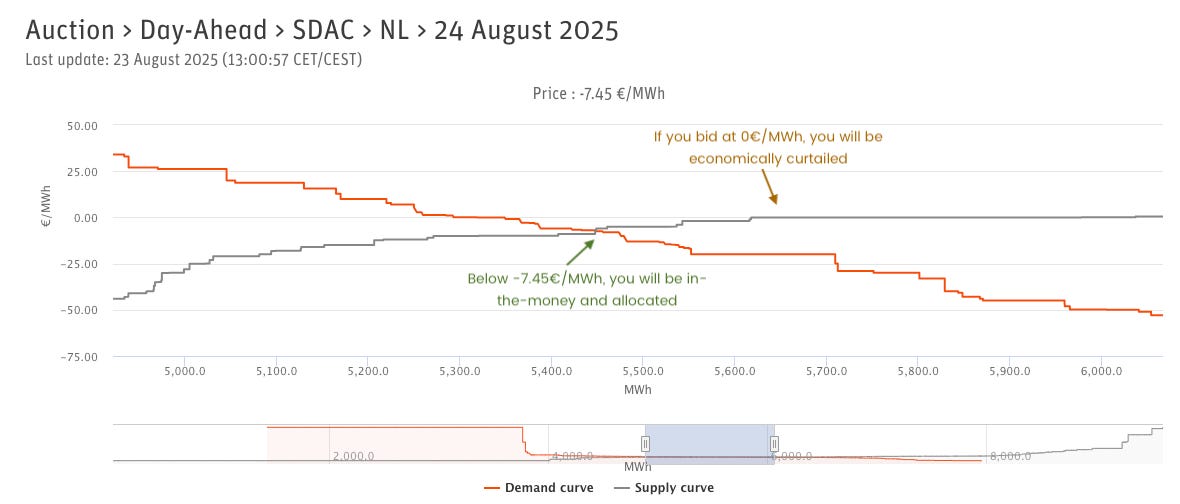
This isn’t just a story about negative prices. When the clearing price is 0 €/MWh, only some 0-priced offers are accepted; others aren’t. We can also see renewables bidding above € 0/MWh to account for other externalities.
Pushing the logic further, if a gas plant bids 80 €/MWh and the market clears at 20 €/MWh, that unit is, strictly speaking, “curtailed” too; it’s out of the money and not dispatched. In practice and in this article, “economic curtailment” is used for renewables assets with near-zero variable costs that price that reality in the day-ahead.
2. Grid curtailment
A second form of curtailment stems from grid constraints, from voltage control to congestion management, typically ordered by the TSO.
The triggers include congestion, voltage limits, insufficient inertia, and similar security needs. These actions are highly local and shaped by network topology.
It can also be referred to as redispatching down. Indeed, an official description of curtailment can be found in the Clean Energy Package regulation as follows:
‘redispatching’ means a measure, including curtailment, that is activated by one or more transmission system operators or distribution system operators by altering the generation, load pattern, or both, in order to change physical flows in the elec tricity system and relieve a physical congestion or otherwise ensure system security;
To gain a deeper understanding of grid curtailment, I will publish a series of articles on grid curtailment in Spain over the following weeks.
3. Flexibility-driven curtailment
It’s a term you’ve likely never heard, but the usual labels never quite fit. The flexibility-driven curtailment encompasses all curtailments related to the energy needs of ancillary services, balancing, and intraday markets.
How does that work? You have been allocated in the day-ahead market; then, you capture value by bidding down to the aFRR market, settling at a negative price. Instead of giving back money to the TSO, you receive money as the price is negative. In those scenarios that happen quite often recently, you would make money by actually not producing electricity.
Sometimes these system curtailments are mandated by the TSO when ancillary liquidity is too low or when the service is not market-based at all.
Deeply negative ancillary prices may appear problematic, but they mostly signal a liquidity gap, an incentive for increased participation and investment in battery storage.
Unlike the other two curtailments, having renewables curtailed for flexibility-driven purposes does demonstrate the value-added flexibility brought by renewables, which should be recognised rather than simply adding it to the total amount of curtailment, especially when this curtailment is market-driven.
In the real world, the flexibility-driven curtailment can be combined with grid curtailment. I personally do not like it, as triggering curtailment for security reasons is often more local than flexibility-driven curtailment.
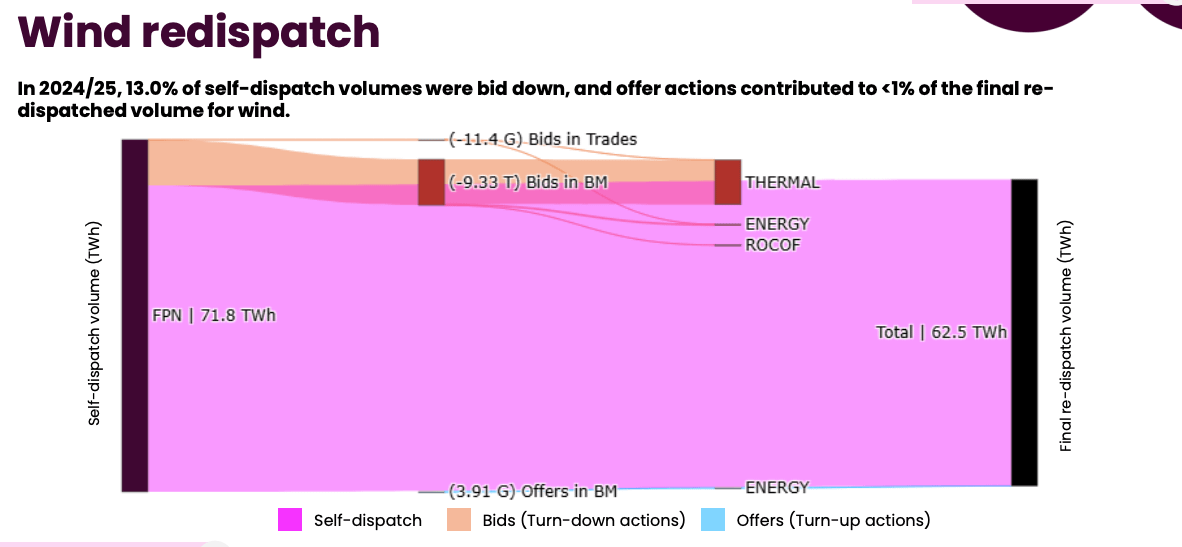
Let’s have a look back at the 9.3TWh of wind curtailment from GB below. When the balancing market was slightly for energy redispatch (Flexibility-driven curtailment), the majority was used for thermal congestion (Grid curtailment).
Market design and remuneration
When discussing grid and flexibility-driven curtailments, we did not address compensation or whether those services were market-based. Indeed, there are no set rules priced those curtailments.
Flexibility-driven curtailment is largely market-driven in many European countries, whereas others still employ non-market-driven curtailment for balancing due to a lack of liquidity in the flex markets or the absence of a market altogether.
Then, for non-market-driven, you can ask yourself the question of how those curtailments will be compensated or if they are at all.
As mentioned, I’ll deep-dive into the grid curtailment topics in a series of 3 articles in the coming weeks.
Before that, a small summary! You could think about renewables curtailment in three ways:
Economical - You’re out-of-merit versus the market-clearing price (Day-ahead), so the unit isn’t scheduled; no operator instruction and no compensation—this generally hurts unless hedged or part of a deliberate self-curtailment.
Grid - The TSO/DSO instructs you to reduce output to meet local security limits (congestion, voltage, inertia, etc.); highly locational and typically compensated under redispatch/constraint-management rules.
Flexibility-driven - You reduce output to provide flexibility products (ID re-offers, aFRR/mFRR/FFR, balancing energy); usually market-based, often with negative prices, providing additional revenue to renewables owners.
Sources:
National Energy System Operator (NESO). (June 2025). 2025 Annual Balancing Costs Report. NESO.
"Volumen und Kosten gesunken." SMARD, Bundesnetzagentur, 2 Apr. 2025, www.smard.de/page/home/topic-article/444/216636/volumen-und-kosten-gesunken. Accessed 24 Aug. 2025.
EPEX SPOT SE. (2025, August 23). Market results: Auction → Day-Ahead (SDAC), Netherlands (NL), delivery 24 August 2025. Retrieved August 25, 2025.
Get the next article by email. A new article on European power markets every other week, from the bid curve to the order book.