Where the Spanish balancing market actually pays a premium over the wholesale price
Seventeen months of post-MARI clearings, and what they actually look like.
Alexandre Danthine · AAG AdvisorsWhere does the Spanish balancing market pay a premium over the wholesale price?
Spain joined MARI, the European platform for mFRR, on 10 December 2024. A single clearing engine replaced the old Spanish algorithm, and one Cross-Border Marginal Price (CBMP) replaced the separate upward and downward prices. An earlier note in the series described that design. This one examines how the price has actually behaved from launch to 23 May 2026, a span of seventeen months, because mFRR pricing is often misread.
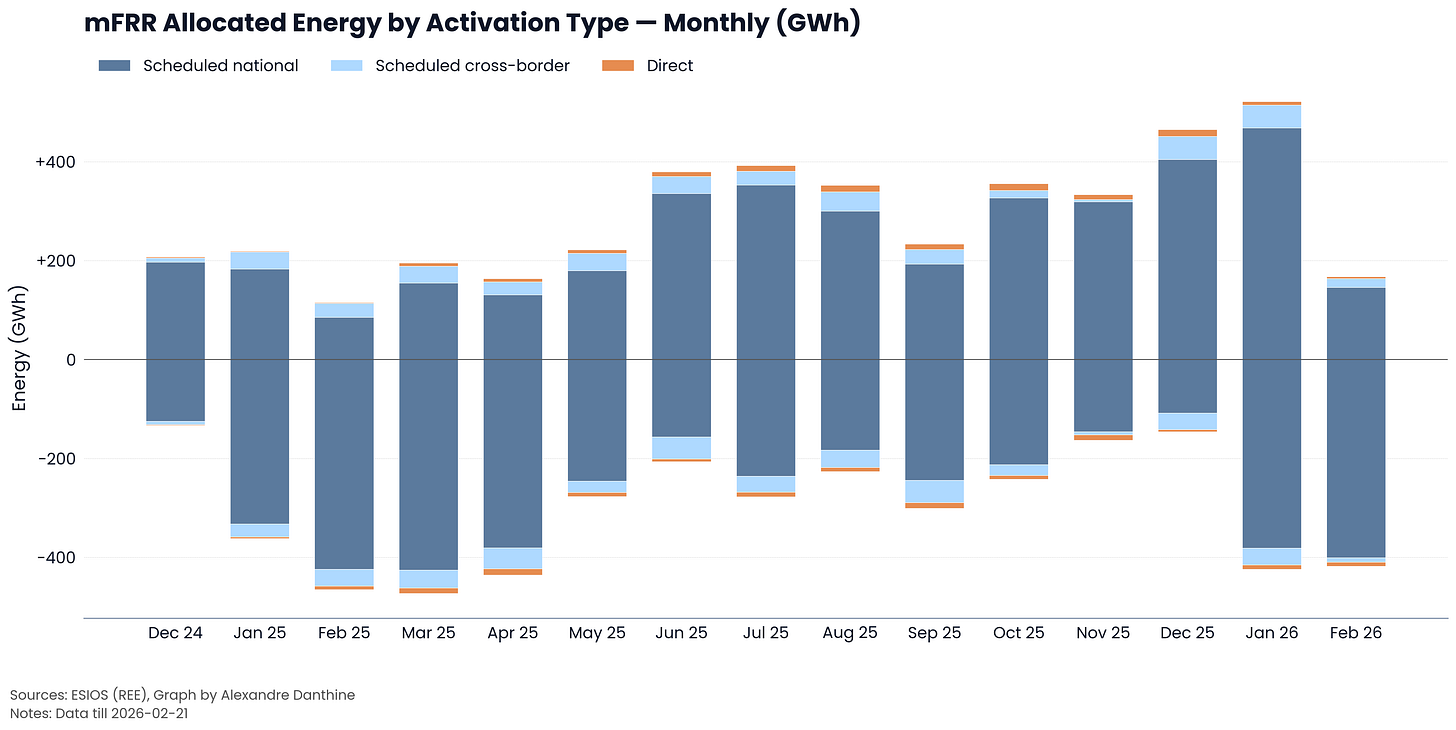
The note first identifies where activated volume clears. Scheduled activation, run each quarter-hour at T-10 minutes, carries almost all of it in both directions. Cross-border netting is still small but should grow now that France has joined in May 2026, and direct activation, between T-10 and T+5, is marginal. Sorting the quarter-hourly CBMP gives a P10 of 119 EUR/MWh, a median of 66 and a P90 of -3. About 76% of quarter-hours are upward and 16% downward. Negative prices occur but mostly stay near zero, and extremes of -2,000 and 1,500 EUR/MWh are rare.
In the full article
- The month-by-month and hour-by-hour CBMP next to the day-ahead spot price, and where the two agree or diverge
- The volume-weighted spread of CBMP over spot when net upward mFRR is activated, by month and hour, and why it is widest in hours compressed by solar
- Three takeaways for pricing flexibility against the post-MARI CBMP
The complete analysis, charts and data are on Substack. Paid subscribers get every article in full, plus the monthly market reports.