Unlocking Continuous Intraday Liquidity
Access, Design, and Incentives for Europe's Continuous Power Markets
Alexandre Danthine · AAG AdvisorsRenewable generation follows weather, not dispatch signals.
With renewable penetration reaching 47% in Europe in 2024, renewable production forecasts are key to ensuring a stable and reliable system.
Despite the best AI models, there will always be some errors (5-20%, depending on the technology) that cannot be corrected, leaving the system short or long while requiring resolution elsewhere.
The question is where.
Traditional day-ahead markets clear 12-36 hours before delivery, when forecast error is still significant. Imbalance settlement lets the TSO handle deviations ex-post, but often at a high cost.
Intraday markets, especially continuous, allow participants to rebalance positions between the day-ahead auction and delivery as long as liquidity is available. Markets with deep, continuous trading make integrating renewables easier and should reduce imbalance costs, as assets can rebalance themselves and avoid those costs.
Battery storage depends on and reinforces intraday liquidity. They earn part of their margin through arbitrage of 15-minute volatility. Once active, they become natural liquidity providers, posting bids and offers across many intervals, tightening spreads, and absorbing forecast errors.
The structural question is no longer whether intraday markets matter, but how to make them work at scale.
While being an essential tool for integrating more renewables and handling their variability, the churn factor in the intraday market is not growing at the same rate across all markets.
Churn factor is the total intraday trading volume divided by total demand.
Germany’s churn rate has increased drastically in recent years due to the growth of renewable energy, battery storage, and an already developed trading industry operating in the futures markets. Nonetheless, countries like Poland saw no changes in liquidity over the past years despite radical changes in their generation mix.
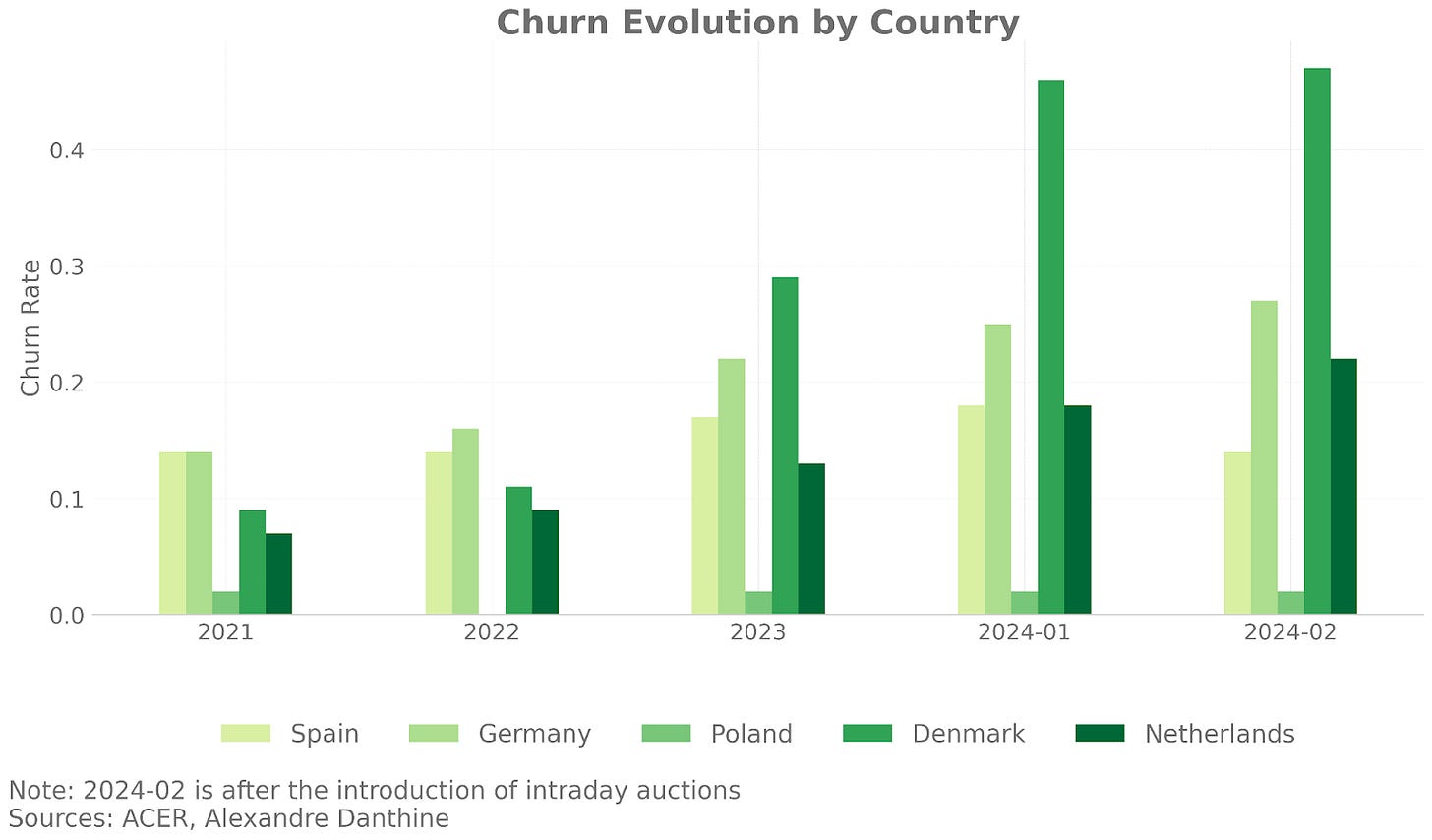
As a core tool for the energy transition, the question is how to improve liquidity in the intraday continuous market. The answer can be framed in three principles: Ease of access, Improve the Market Design, and Create the right incentives.
Ease of access
The principle is to lower barriers for new foreign participants and enable a broader range of assets, whether demand-side or generation, to participate more easily in continuous intraday markets.
Financial Barrier Reduction
Current membership and collateral frameworks rely on fixed annual fees and standardised guarantees that are proportionally heavy for small aggregators. Volume- and risk-based tiers for fees and collateral would better align costs with traded risk while preserving Central Counterparty (CCP) protection.
Regulatory Harmonisation
Divergent national licensing forces aggregators to redo similar checks and setups in each country. EU-level mutual recognition or passporting would reduce duplication and speed cross-border liquidity provision.
Independent Aggregator Enablement
An independent aggregator bundles distributed energy resources (DERs), batteries, demand response, and small generators to participate in wholesale markets without being the customers’ electricity supplier.
While the EC mandates the implementation of an independent aggregator, some countries still do not have a finalised independent aggregator framework … leaving flexibility on the table.
Improve the Market Design
Even with easier access, intraday liquidity does not magically appear; it has to be worth traders’ time.
That depends on the structure of the market: how cross-border capacity is allocated, how products are defined, when gate-closure occurs, and whether order types match how portfolios are actually managed.
The goal is to make the continuous intraday market the natural place to manage 15-minute risk, not a last-resort venue between day-ahead and imbalance.
Cross-border integration
The more interconnected the order books, the more liquidity is available, the more traders will be there. Europe has already taken a significant step with SIDC/XBID, but interconnecting European countries increases trade volumes.
Intraday traded volumes across all regions increased from 4 TWh in 2019 to more than 20 TWh per month in 2025.
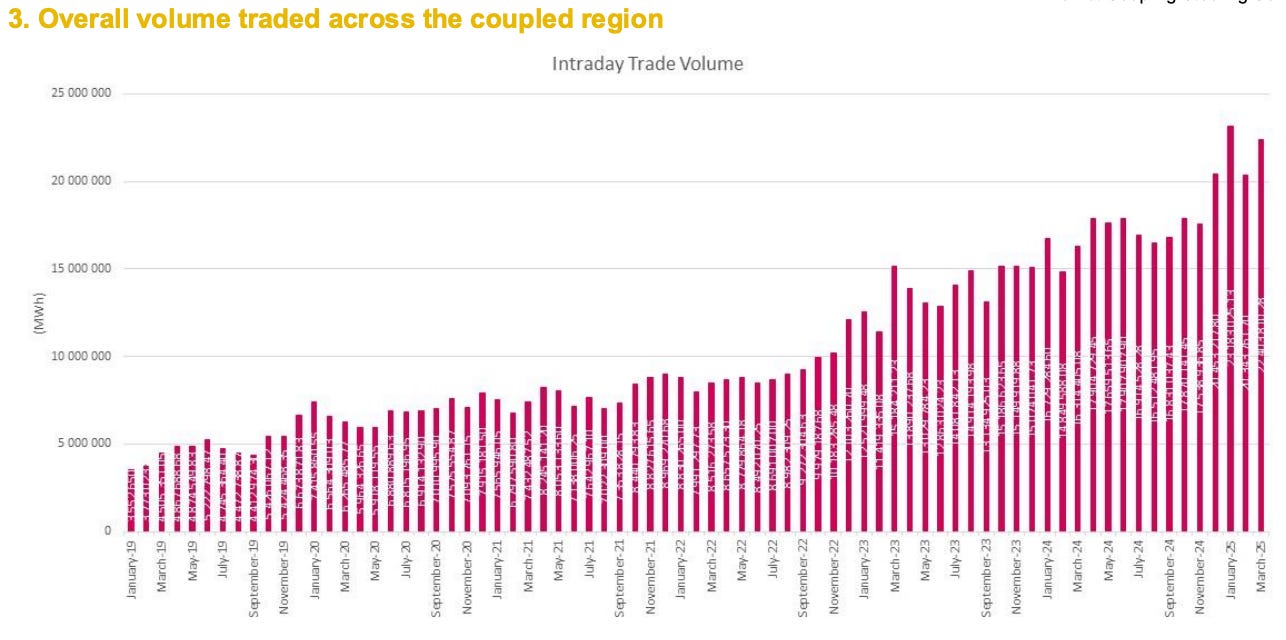
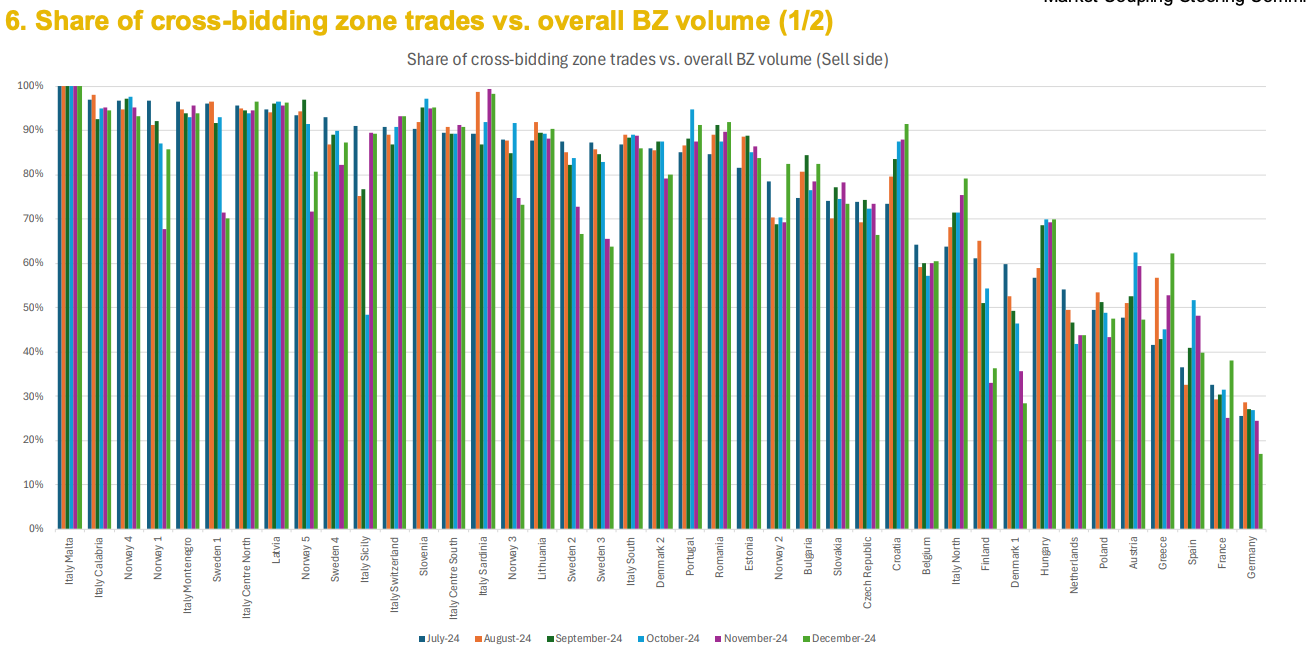
While this increase could come from more renewables and greater market flexibility, which is partly the case, a good metric to assess the cross-border impact is the share of cross-border trade relative to overall Bidding Zone volumes.
Only a handful of countries have more than 50% of their generation coming from their internal bidding zone (Germany, France, and Spain). The volumes observed during continuous intraday trading in most countries vary by exchange, underscoring the importance of cross-border trading in this market.
Product granularity
The second design lever is product design. Shorter products and later cross-border gate closures pull intraday trading closer to the system’s physics.
Moving from hourly to 15-minute products, aligned with the imbalance settlement period, lets prices reflect rapid swings in wind, solar, and demand rather than averaging them away in a blunt hourly block.
At the same time, shifting cross-border gate closures from 60 minutes to 30 minutes — which is planned for 1st of January 2026 but delayed by many derogations — gives traders the ability to adjust positions with much fresher forecasts and to use interconnectors to arbitrage imbalances, rather than leaving them to redispatch and balancing.
Together, finer granularity and near-real-time cross-border access deepen liquidity exactly where uncertainty is highest: in the last hour before delivery.
Other considerations
There are more innovative ways to attract liquidity. Denmark and the Netherlands, for instance, channel a share of congestion management through the intraday market. In the Dutch case, GOPACS facilitates local flexibility, though its use remains modest, and, in Denmark, from November 2022 onwards, countertrading has been sourced via intraday transactions.
While this broadens participation, it also creates pockets of market power: assets sitting at the correct node or in a constrained area can bid higher because they are the only ones able to resolve that specific congestion effectively.
Create the Right Incentives
Imbalance pricing as the primary demand signal
The point of rebalancing against forecast error is simple: avoid costly imbalance settlement. When the imbalance penalty bites, producers would rather tidy up their positions in advance than pay for being wrong in real time.
The key signal is the gap between the imbalance settlement price and the continuous market price. A large gap prompts BRPs to fine-tune their portfolios; a small one makes accepting residual imbalances a rational choice.
One policy lever is to allow TSOs to “uplift” imbalance prices. Put simply, you make the imbalance price higher so agents prefer to balance themselves rather than force the TSO to deploy reserves.
It is what the Belgian approach is: a scarcity adder, alpha, that ramps up as system imbalance widens, sharpening the incentive to clear positions early.
Market maker schemes for structural liquidity.
A market maker is a trading entity that continuously posts firm buy and sell quotes for specified products, standing ready to transact at those prices to provide liquidity and reduce bid–ask spreads.
Market makers in continuous intraday power markets are contracted or obligated players who stand ready to post two-sided quotes with minimum volumes and maximum spreads for key products and hours. Schemes range from voluntary, incentive-based programs like Nord Pool’s (fee rebates, free membership in exchange for tight, continuous quoting) to mandatory obligations such as Great Britain’s former MMO, where large utilities had to quote within defined windows.
Market makers are most useful where natural liquidity is insufficient for efficient rebalancing. In these markets, committed quoting can narrow spreads, stabilise prices, and give renewables and small BRPs a reliable way to trade close to real time.
Conclusion
Unlocking continuous intraday liquidity isn’t about inventing new markets, but making existing ones truly usable: lower access barriers, smarter cross-border/product design, and well-calibrated imbalance and market-maker incentives. When those three align, intraday stops being a residual clean-up venue and becomes the core operating layer of a renewables-dominated power system.
Sources
https://ec.europa.eu/eurostat/en/web/products-eurostat-news/w/ddn-20250319-1
ACER. (2025). Progress of EU electricity wholesale market integration: 2025 monitoring report. European Union Agency for the Cooperation of Energy Regulators.
International Energy Agency. (2025). Electricity market design: Building on strengths, addressing gaps. International Energy Agency.
Get the next article by email. A new article on European power markets every other week, from the bid curve to the order book.