Who is actually making Spain's balancing market?
A technology-level read of the post-MARI bid stack: who provides the upward megawatts, who absorbs the downward ones, what each technology earns, and how much renewables have already been paid to come
Alexandre Danthine · AAG AdvisorsWho is actually making Spain's balancing market?
Earlier notes in this series covered the post-MARI design and the behaviour of the Cross-Border Marginal Price (CBMP). This one asks which technologies stand behind that price on each side. Balancing energy in Spain has traditionally come from thermal and hydro plants. The note looks at how renewables now fit in, what each technology earns, and what the bid book looks like at two reference quarter-hours.
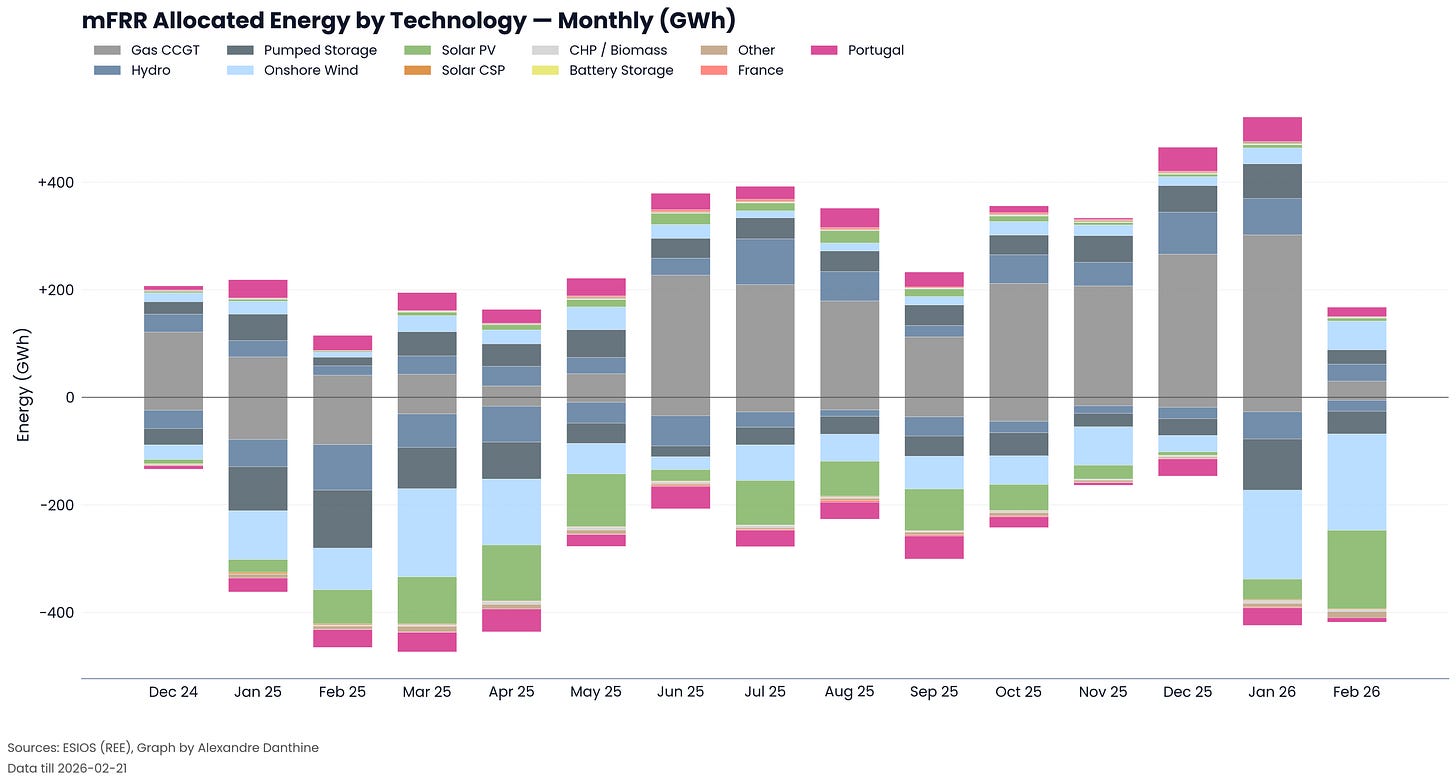
Across 15 months of post-MARI data, gas CCGTs lead upward activation in every month, with hydro and pumped storage second and renewables small. On the downward side, onshore wind and solar PV carry most activated energy in spring and summer, and February 2026 is the most renewable-dominated month. Around midday, solar absorbs over 200 MWh per hour on average. Renewables also supply some upward energy in most hours through asset optimisation: units that bid cautiously in earlier markets offer their spare output upward. Gas leads upward in the evening peak and at night. Renewables have earned several million euros from downward activation.
In the full article
- Volume-weighted CBMP per technology by month and hour, and why timing rather than technology explains the differences
- The structural difference in downward bidding between thermal and renewable units, and how it sets the price gap
- The full bid book on two reference quarter-hours: a midday solar hour at -3 EUR/MWh and an evening peak at 100.9 EUR/MWh
- The total paid to each technology for downward activation at negative CBMP over the 15 months
The complete analysis, charts and data are on Substack. Paid subscribers get every article in full, plus the monthly market reports.