What is the most profitable market for a battery in Spain?
The capacity market is getting the headlines, but most of a battery’s revenue sits elsewhere. A map of day-ahead arbitrage, balancing services and technical restrictions.
Alexandre Danthine · AAG AdvisorsCapacity markets have been a recurring topic in Spain recently. After the European Commission approved the Spanish scheme at the end of May, the Ministry for the Ecological Transition (MITECO) announced the ministerial order on 16 September that sets up the first capacity market for the peninsular system.
Despite the lack of clarity on a few key characteristics of this capacity market, battery developers have been told it's the missing piece of the business case.
I would be more cautious.
The capacity market will be open for the existing Spanish CCGT fleet of 24.5 GW, which needs a little additional money to cover its fixed costs. On top of that, a large part of the battery pipeline, around 3 GW, has already received public subsidy, which would need to be priced into their bids.
With that supply, we can expect the auctions to be really competitive, with a low clearing price and capacity payments representing only a small share of the revenue stack.
If my assumptions are right, the more important question is which other revenue streams will provide most of the revenue. In the following part of the article, I will give an understanding of how much a battery can earn from day-ahead arbitrage recently, how much value could be extracted from the balancing services in the past years, and whether we missed a big value driver specific to Spain.
Day-ahead arbitrage: the spread keeps widening
The simplest battery revenue is to charge when prices are low and discharge when they are high.
The most common way to quantify this opportunity is the TB2 spread: the average of the two most expensive hours of the day minus the average of the two cheapest ones.
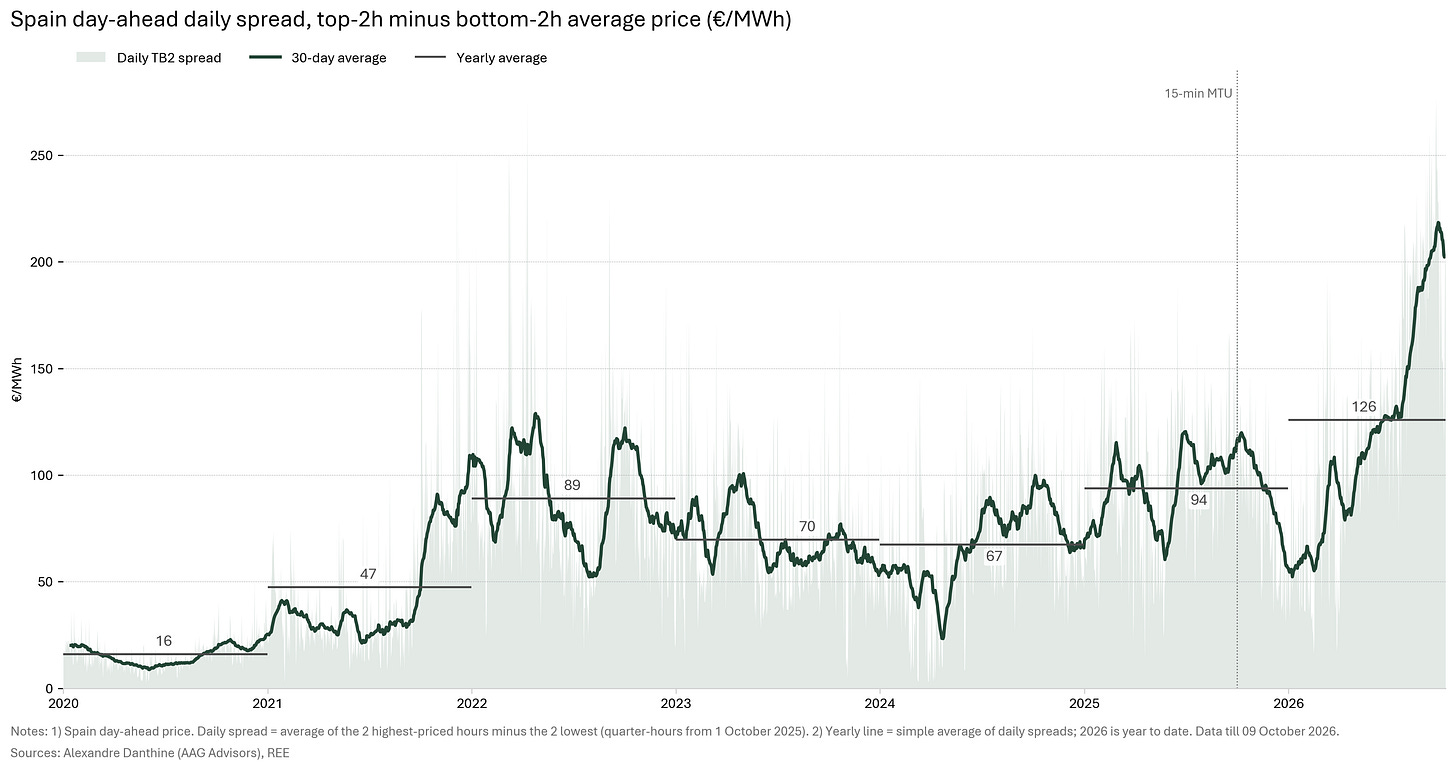
After the 2022 energy crisis, the spread settled around 70 EUR/MWh in 2023 and 2024. Spreads have since risen to an average of 94 EUR/MWh in 2025 and 126 EUR/MWh so far in 2026.
In recent months, the 30-day average went above 200 EUR/MWh in September, a level not seen even in 2022.
Two factors drive this.
Continued growth in solar capacity pushes midday prices toward zero, or below, on more days of the year.
The recent rise in gas prices also pushes evening prices higher, when combined cycles are at the margin.
What does this mean for a battery?
The next graph translates the spread into revenue for a two-hour battery with a 90% round-trip efficiency, cycling once a day on the day-ahead market only.
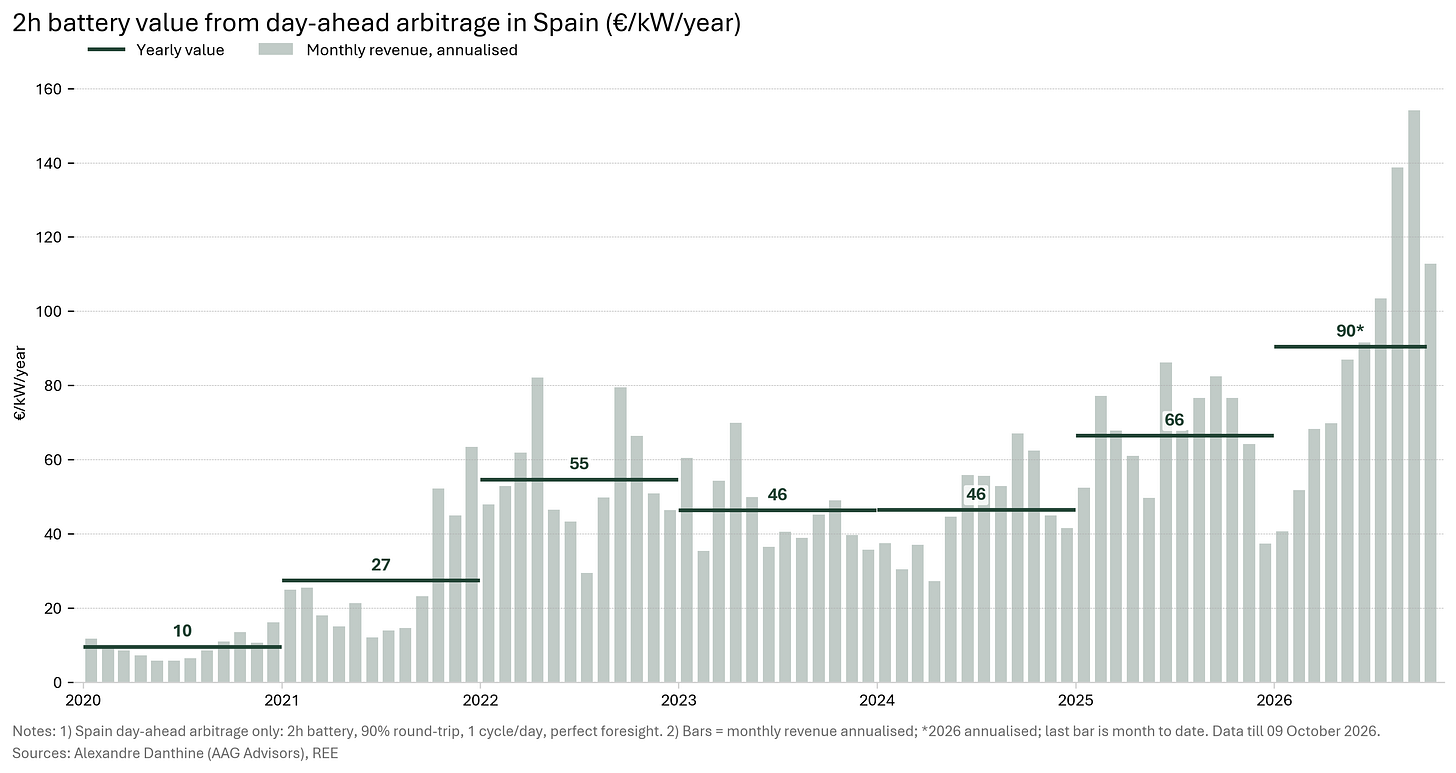
The value follows the spread closely.
In August and September, the monthly run-rate was above 135 EUR/kW/year.
Despite assuming perfect foresight, which could lead to thinking that those figures are conservative, they omit the possibility of doing more than one cycle, as well as trading in the intraday market, resulting in potentially higher revenues.
Around 90 EUR/kW/year from day-ahead arbitrage alone is a decent result for a two-hour asset comparing to the CAPEX level we see in the market these days.
Balancing markets: where early battery markets make their money
As in most markets at the start of battery deployment, balancing markets should be the first source of revenue. Spain is still at that stage: Red Eléctrica reports around 320 MW of installed battery capacity in October 2026, a very small volume compared with the size of the balancing markets.
Four products are used to keep the frequency stable. Frequency containment reserve (FCR) is the fastest one, but unlike most European markets, it is not remunerated in Spain: it is a mandatory service provided by generators. Automatic frequency restoration reserve (aFRR) is activated within minutes by a control signal from the TSO. Manual frequency restoration reserve (mFRR) and replacement reserves (RR) are slower and are activated on instruction to replace the faster reserves.
To quantify how much money flows through each product, I use a simple approach. For aFRR capacity, I take the assignment cost published by REE. For upward energy, I multiply the activated volume by the price. For downward energy, the provider only receives money when the price is negative, so I only count those periods, again as volume times price. This is an approximation, as it gives the gross amount paid to providers and not their margin, but it gives a consistent order of magnitude across products.
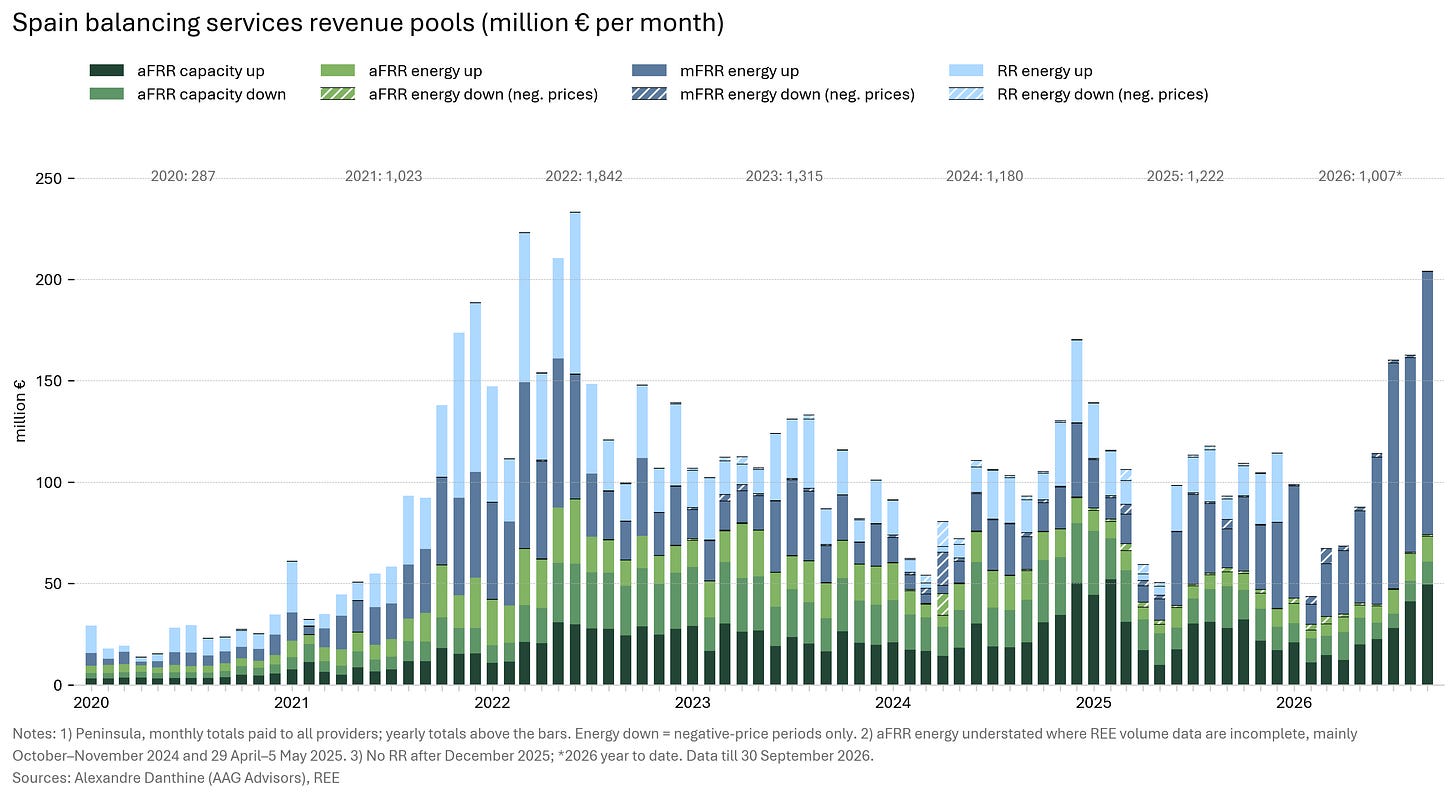
aFRR is the only product that pays for capacity, and it remains one of the most profitable markets for a flexible asset. The capacity payment is stable month to month, and it has been increasing again in 2026: capacity alone reached around 50 MEUR in September, the highest monthly value in the series.
Volatility is more pronounced in energy products that track gas prices more closely, which explains the 2022 peak and the recent rise.
Regulation is another factor behind these changes.
In November 2024, Red Eléctrica launched its new secondary regulation service, which assigns aFRR capacity through separate merit orders for upward and downward capacity, so each direction is now priced on its own. On the energy side, Spain connected its balancing markets to the European platforms, which replaced the purely local merit orders: mFRR joined the MARI platform on 10 December 2024, and aFRR joined PICASSO on 19 June 2025.
I described what the move to MARI changed for mFRR prices in a previous article. Finally, replacement reserves, the slowest product, ended on 30 December 2025, when Red Eléctrica disconnected from the European TERRE platform.
The consequence of the last change is the most visible, as the volume coming from RR translated into mFRR value.
To show the split more clearly, the following graph shows the full year 2025.
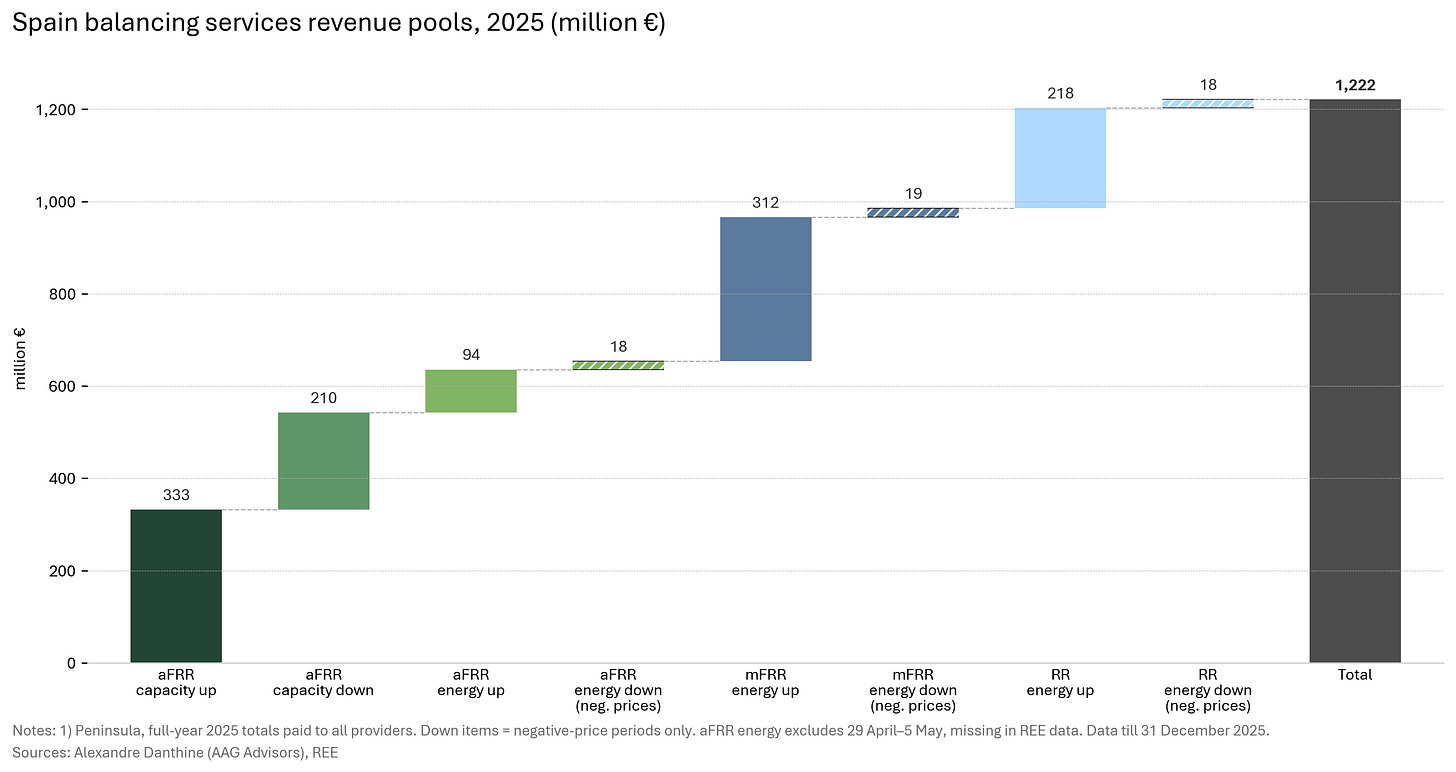
In 2025, around 1.2 bn EUR was paid to balancing providers.
For batteries, the key factor is the ratio between pool size and the fleet that can compete for it.
Around 320 MW of batteries face a pool of more than one billion euros per year. That will not last as the pipeline gets built, but it explains why balancing is the first market developers look at.
The elephant in the room: Technical Restrictions
So far, I have not mentioned the largest market of all.
The technical restrictions market helps Red Eléctrica solve security problems on the grid after the day-ahead market clears: congested lines, voltage control, or a lack of available reserves in a given area.
It operates on a pay-as-bid basis, and plants are called on depending on their location. I have described how it works and why its costs keep growing in previous articles.
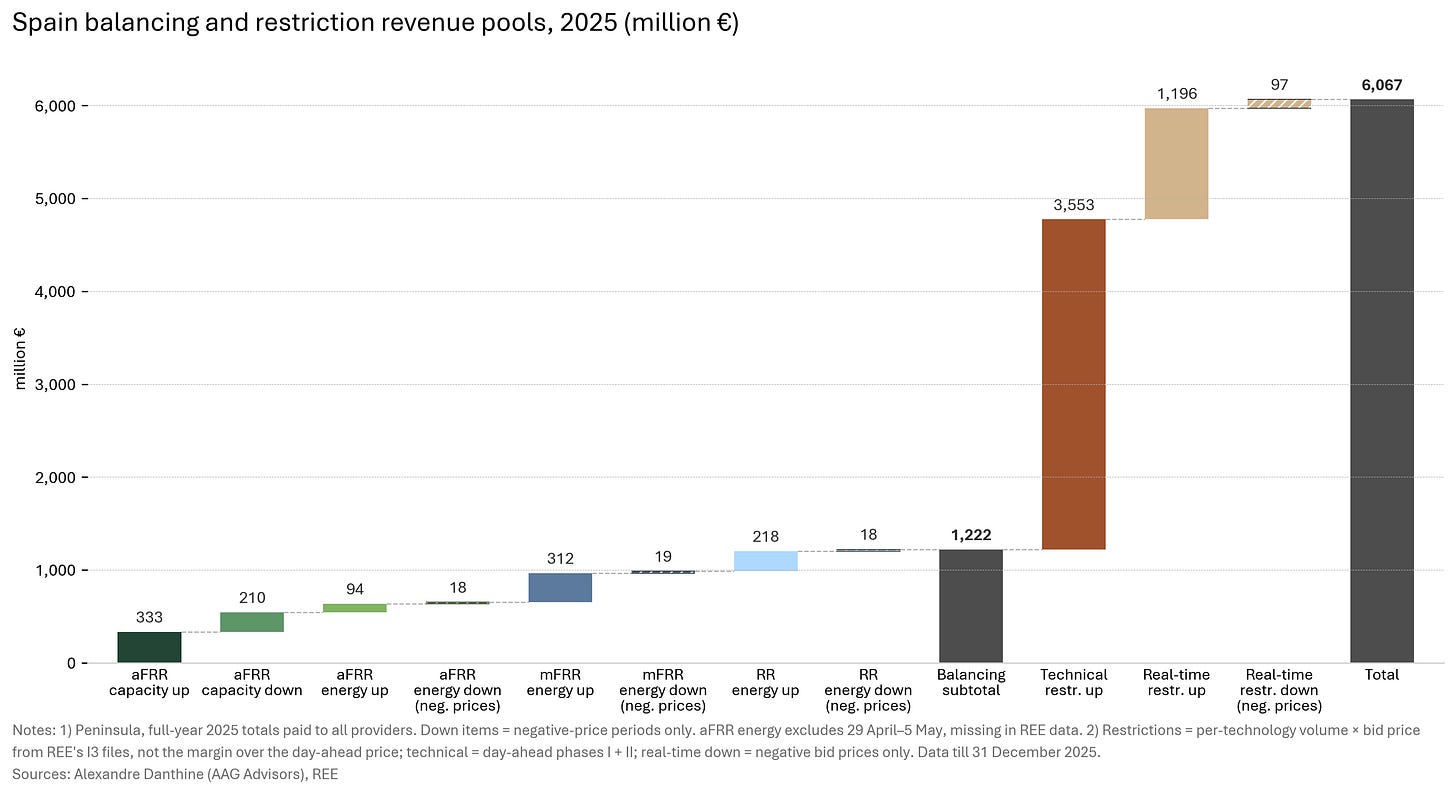
The value to be extracted in the technical restriction dwarfs the 1.2bnEUR just mentioned in the balancing market, as it is nearly 5-fold larger.
As a reminder, these figures are gross payments, not margins; nonetheless, the magnitude suggests that even a small share of this market would significantly increase revenues.
Those markets are harder to manage because they are highly local, and a battery can only be useful if it sits where the grid needs it. Batteries barely participate in this market, which CCGT still serves almost entirely.
It raises three questions that I will address in follow-up articles:
Where is the technical restriction located in Spain?
How is the price distributed across the country, and where are the calls the most expensive so far?
Can batteries actually replace the plants currently allocated in this market?
After this set of articles, you should have a better view of how much of those 5Bn EUR batteries will capture and whether the Technical Restrictions market is the most profitable market in Spain.
If you found this analysis useful, share this article with someone following the Spanish market.
Cheers,
Alexandre
Get the next article by email. A new article on European power markets every other week, from the bid curve to the order book.