When Not Producing Pays: The Paradox of Curtailment Revenues
Spain’s real-time market shows how renewables earn millions from grid congestion
Alexandre Danthine · AAG AdvisorsCan you make money from curtailment?
Curtailment is often portrayed as detrimental to electricity generators.
However, it is not always the case.
What are the main routes to make money from renewable curtailment?
Downward ancillary energy at negative prices
By bidding negatively in ancillary services energy downward (e.g. aFRR, mFRR, …), you’ll be paid to reduce output, i.e., you earn money for turning down when the TSO activates you.
Capacity revenues for ancillary services
Sometimes the upside is the capacity payment (FCR, aFRR, etc.). You accept the risk of being dispatched; curtailment is then a cost/opportunity you tolerate to capture capacity prices.
Avoided losses
Curtailment can help you avoid imbalance charges or selling into negative day-ahead/intraday prices.Hybridisation with storage
Pair with batteries to store what would otherwise be curtailed. Turn “free/lost” energy into later revenue.Congestion management
Depending on the regulation, you may be paid (or at least not penalised) for helping relieve local constraints. This article focuses on that last pathway.
While the most common way to make money from curtailment is often linked to ancillary services, we will examine the revenues generated from grid curtailment.
If you followed my recent articles on curtailment (Type, Legal & Location), we will not look at day-ahead grid curtailment in Spain, but rather its real-time counterpart.
The reason I’ve examined this topic is due to the significant change in the cost pattern of Real-Time Technical Restrictions over the last few months/years. See below.
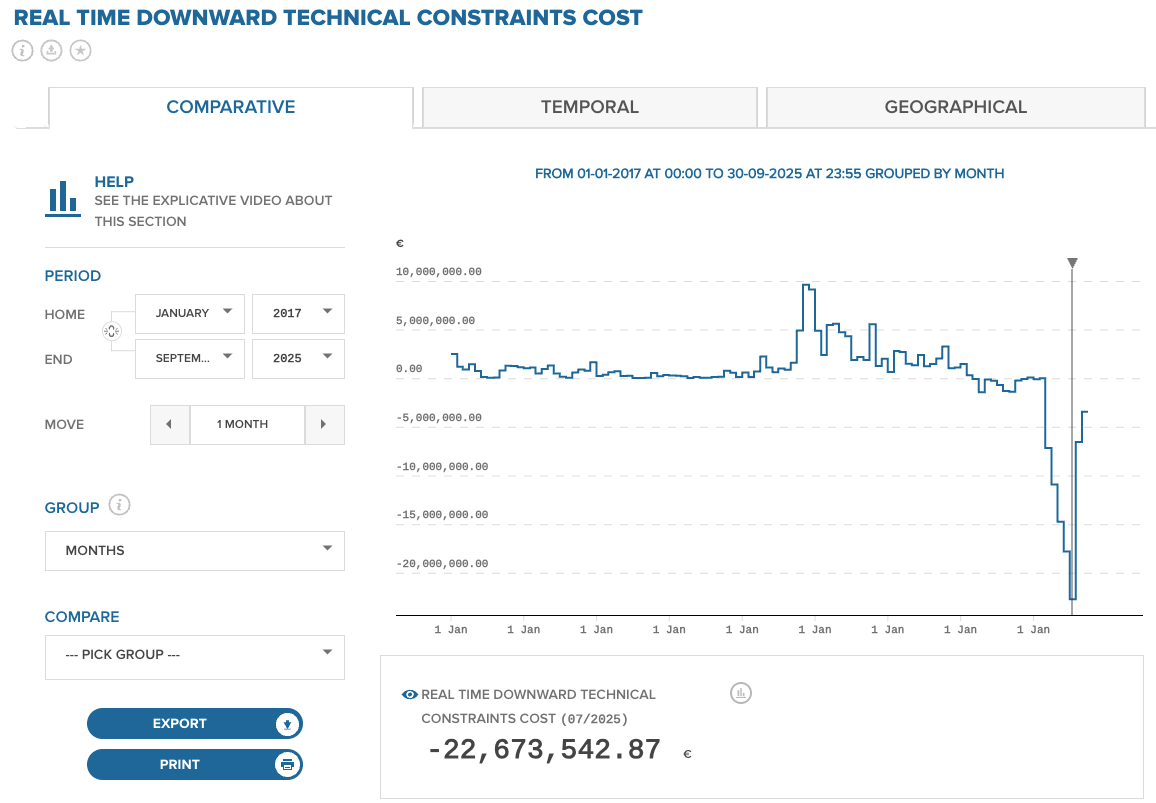
A positive cost for a downward service means that the generators are bidding at a positive price, giving money back to the TSO. The opposite would mean that the generators would bid negatively in this market, creating a line of revenue for them as the TSO would need to pay them to turn down.
It seems to be what happened in the last two years…
Unlike the day-ahead Technical Restriction downward, its real-time counterpart allows market participants to bid the prices they want*. If market participants do not bid in this market, they might be forced to redispatch at a set price due to security reasons.
The interesting part of this graph is the change of behaviour of this downward market that was historically positive while going heavily negative in the last 12 months, reaching a cost of -22.7M€ during July 2025, which adds to the total cost of congestion management in Spain already going beyond 2.5B€ as we speak this year.
Let’s look at the reasons and the technologies curtailed, and then lastly, the prices at which it was curtailed.
The reasons for those curtailments are pretty straightforward. We observe that most volumes are used for congestion in basecase or in contingency mode, indicating that the lines are overloaded.
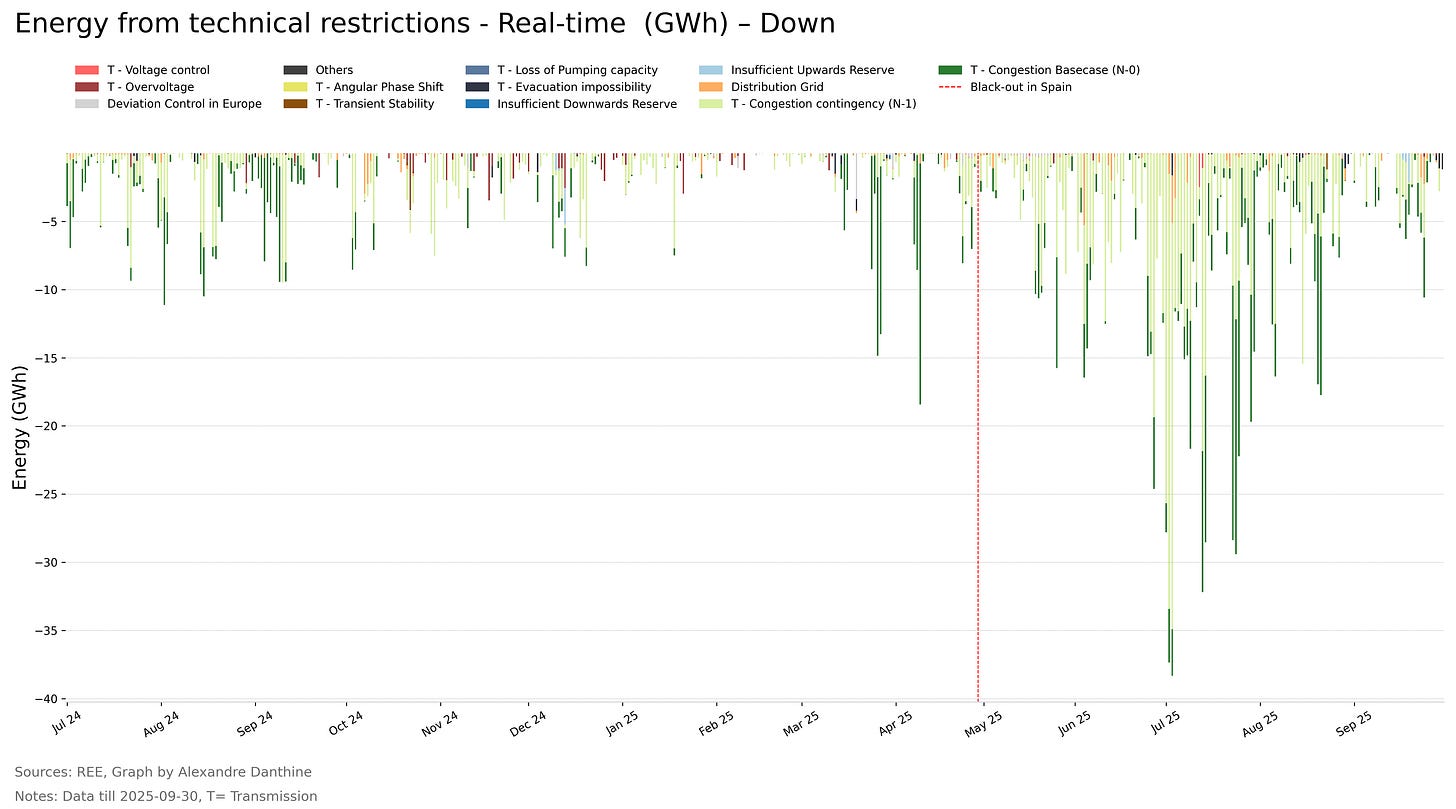
Those volumes increased a lot after the blackout, totalling more than 400GWh for July 2025.
From a TSO perspective, I find real-time curtailment due to base-case congestion quite concerning. If those measures were not taken, Spanish lines could overheat and melt. It illustrates how constrained the grid might be in certain parts of Spain.
The technologies behind curtailed energy evolved significantly over time, with pumped storage and wind being the primary sources until 2022. After that, we saw solar PV becoming one of the technologies with the largest curtailment in this market, again, spiking at more than 200GWh in July 2025.
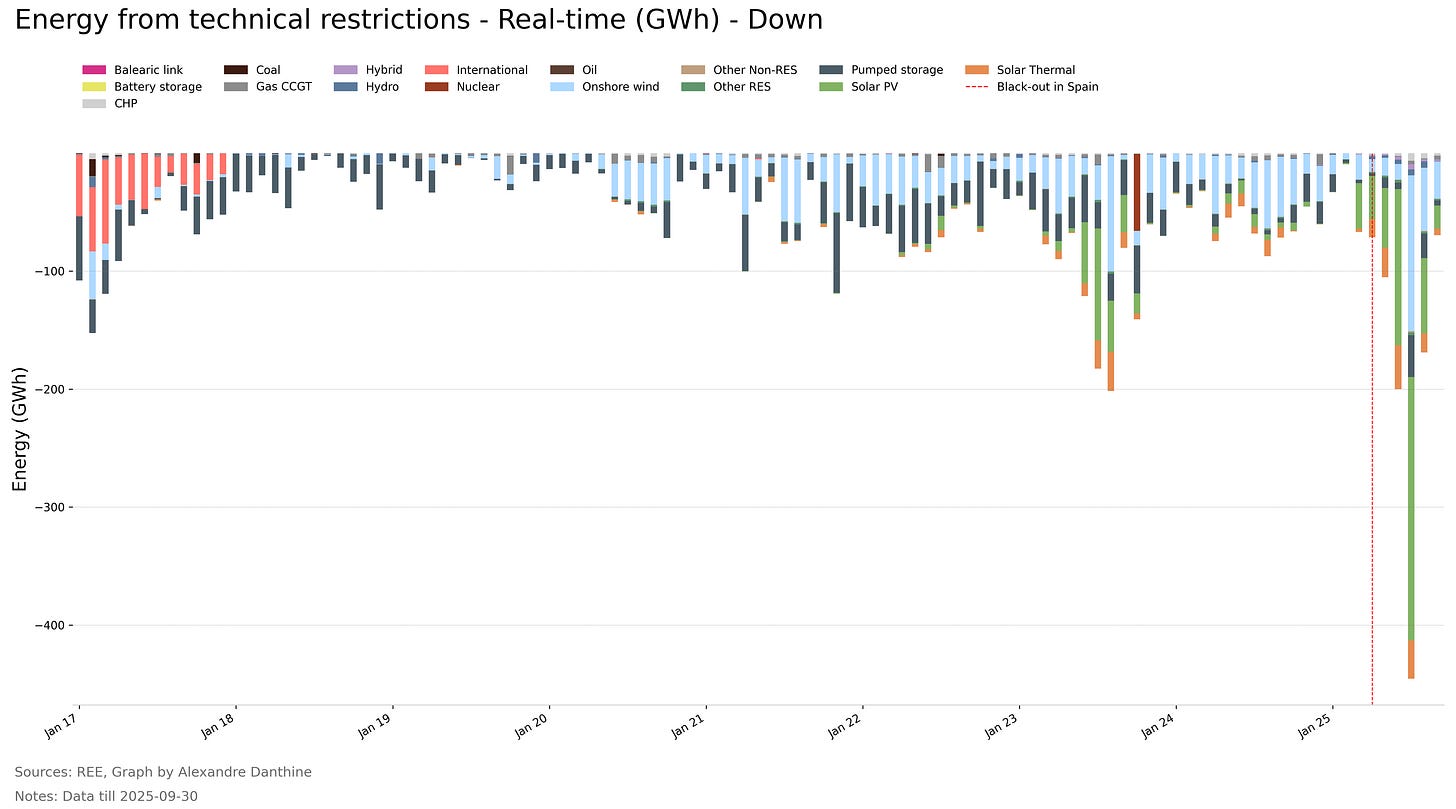
While we see the volumes tend to increase and renewables taking a larger part of that curtailment, we still cannot understand why the cost reverses so aggressively.
The prices bid by renewables in this market have undergone significant evolution over the last eight years.
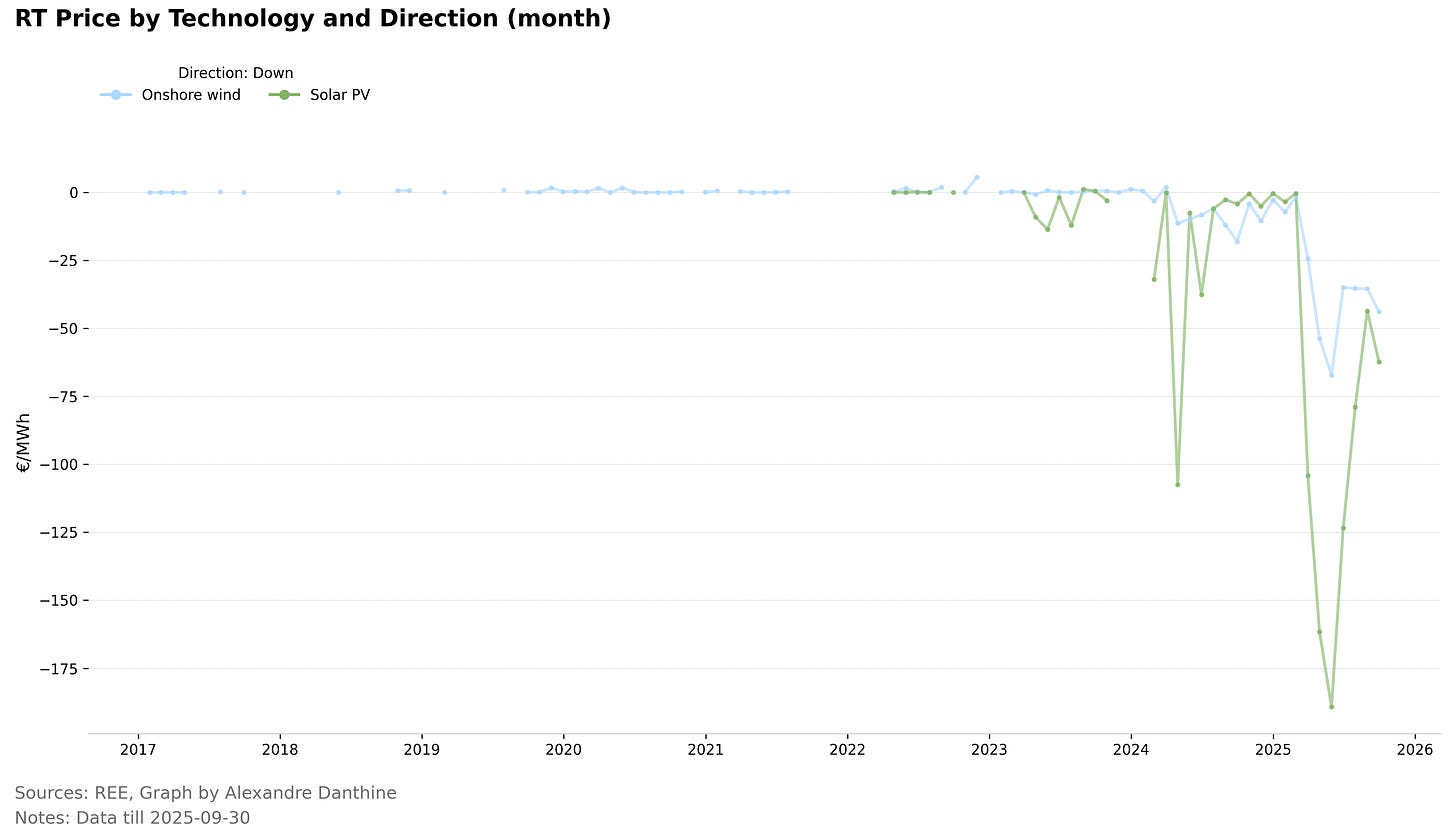
From the graph, you can understand that some regulatory changes happened in 2024.
On the 12th of July, BOE-A-2024-11959 entered into force, allowing the final bidding negatively under the following rules. An earlier version entered into force on the 28th of March, which only addressed the €1/MWh rule.
Price of the energy offered: This price may be negative in all programming periods in which the marginal price resulting from the daily market or any of the intraday market auction sessions has been less than €1/MWh in one or more of the periods of the programming horizon corresponding to the day in question. This validation shall apply from the moment the SO has integrated the marginal prices of the daily market or any of the intraday auction sessions into its system. The price of the restriction offer may not be lower than the lower technical price limit established, where applicable, for offers to the daily market, or the lower of the daily minimum and the intraday auctions if both are different.
While this change of regulation certainly intended to reduce the number of negative prices in this real-time Technical restrictions market, it has legalised an unwanted behaviour.
Indeed, the regulation did not mention anything about negative prices before, which left generators in the dark.
How do we feel about paying solar and wind, more than 50 €/MWh, not to produce, as they solve congestion?
REE, by changing the law, made an unwanted behaviour totally legal.
To return to first principles, does it make sense to solve congestion through a market mechanism when liquidity is low?
In the context of congestion management, you want to avoid the possibility of people gaming the market. While here, we leave an open door …
Yes, battery can help. Yes, it might incentivise the deployment of generation/flexibility at the right place.
But here, the market design seems off …
Get the next article by email. A new article on European power markets every other week, from the bid curve to the order book.